

CI&DEI
IN NUMBERS
➝ SCIENTIFIC PRODUCTION
➝ RESEARCHERS
➝ PROJECTS
international
national
internal
non-competitive
CI&DEI
mission
To conduct high-quality educational research in school and non-school contexts, supporting innovative socio-educational projects and interventions.
Promote interdisciplinary research and digital collaboration, addressing complex educational challenges and fostering science, culture, and societal impact.
vision
To act as a catalyst for transformative change in education, promoting sustainability, territorial cohesion, holistic lifelong education, diversity, innovation, and social responsibility.
values
➝ Excellence and societal relevance
➝ Scientific integrity
➝ Social responsibility and global cooperation
➝ Socio-cultural, economic, and environmental sustainability
strategic
priorities
➝ Strengthen teacher education quality, reinforcing the link between practice and theory, promoting interdisciplinarity and multiculturalism, fostering learner-centered approaches, critically using digital resources and AI, and cultivating critical thinking.
➝ Enhance integration and territorial cohesion in education by researching local learning approaches and territorial asymmetries.
➝ Promote environmental, social, and cultural sustainability through research and:
STRATEGIC AXIS
A | RESEARCH
Research on holistic and inclusive lifelong education, in both formal and non-formal learning contexts.
B | COMMUNITY ENGAGEMENT
Educational research and intervention with and within the community, aiming for a transformative impact on its sustainability, with an emphasis on equity, quality education and health, and social justice.
C | INNOVATION AND TRAINING
Research within a culture of innovation, with a transformative impact on training, particularly of educational and socio-educational agents.
ORGANIZATION
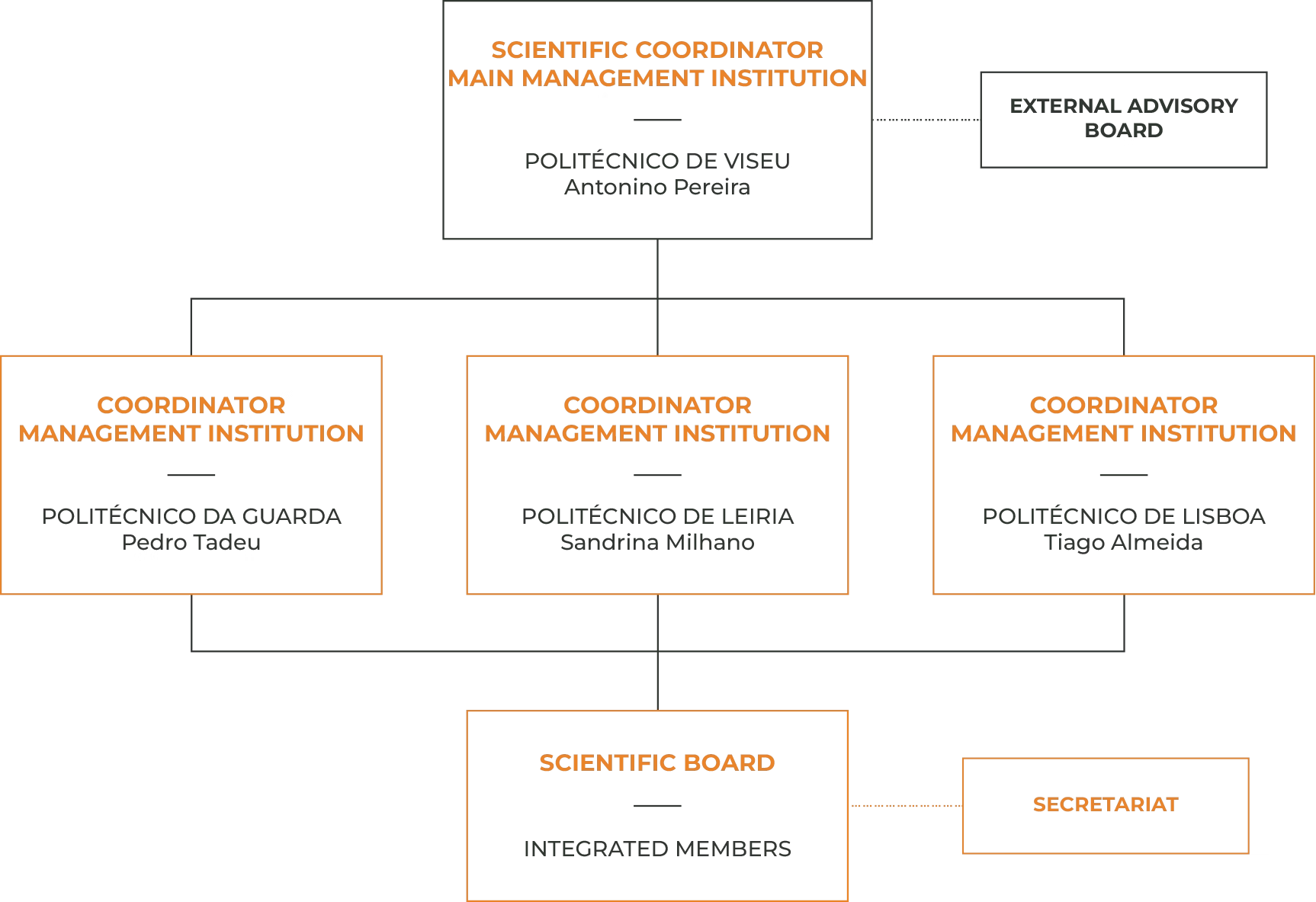
CI&DEI seeks to enhance coordination and management, as well as to foster interaction and synergy among its members
The management bodies for the 2025-2029 period include: the scientific coordinator; the board; the scientific council; the scientific coordination committee (composed of the board and the coordinators of each research line); and the external advisory board.
SCIENTIFIC COORDINATOR
PRINCIPAL RESEARCHERS
OF THE MANAGING INSTITUTIONS
EXTERNAL ADVISORY BOARD
Jose Maria Fernandez Batanero | Universidad Sevilla, Spain
Rui Manuel Marques | Instituto Padre António Vieira, Portugal
Joe O’Hara | Dublin City University, Irland
Margarida Gaspar de Matos | Universidade de Lisboa, Portugal
Petra Grell | Technische Universität Darmstadt, Germany
Jorge Arroteia | Universidade de Aveiro, Portugal
Carlos Alberto Vilar Estêvão | Universidade do Minho, Portugal
RESEARCH
LINES
Simultaneously, it develops research in Didactics for transformative and innovative education, oriented towards critical citizenship and sustainable development.
integrated
collaborator
Its objective is to promote behaviors that improve health and well-being through innovative learning experiences, while simultaneously fostering equity, inclusion, and health for all.
integrated
collaborator
It addresses issues such as discrimination, migration, and cultural adaptation, with special emphasis on the study of accessibility and integration of people with disabilities and inclusion through sport.
Committed to inclusive education, it seeks to contribute to the understanding of social phenomena and to the promotion of educational practices that foster equality and active participation in society.
integrated
collaborator
integrated
collaborator
DOCUMENTS
RULES
Regulation
Researcher Guide
Logos and advertising guidelines
Financial Execution Standards of FCT 2020-2023
FORMS
imq0801pt • request for financial support • participation in scientific meetings/conferences • translation • review • submission
imq0812pt • shared expense
imq0813pt • new member proposal
imq0401 • internal requisition of need
INTERNAL FUNDED PROJECTS
Regulations • Internal funded R&D projects
Submission form for internal funded R&D projects
INTERNAL NON-FUNDED PROJECTS
Regulations • Internal non-funded R&D projects
Submission form for projects